Showing posts with label RMLI. Show all posts

14 July 2024

Reporting for duty

As I mentioned in a previous post, The Men Who Would be Kings ruleset requires that each unit has a leader figure, so I have now added three more personalities to lead the Empire units.

Lieutenant-Colonel Alfred George Huyshe CB commands 1bn Princess Charlotte of Wales’s (Berkshire) Regiment, Colonel Sir Cromer Ashburnham KCB commands 3bn King’s Royal Rifle Corps, and Lieutenant-Colonel Albert Henry Ozzard commands the Royal Marine Light Infantry contingent in HMS Tyne.

Left-to-right: Lieutenant-Colonel Alfred George Huyshe CB, Lieutenant-Colonel Albert Henry Ozzard, and Colonel Sir Cromer Ashburnham KCB.

08 July 2024

Game markers and British unit leaders

I’ve finished a small set of 16 game markers, which I hope will be enough, and the three leader figures are ready for varnishing.

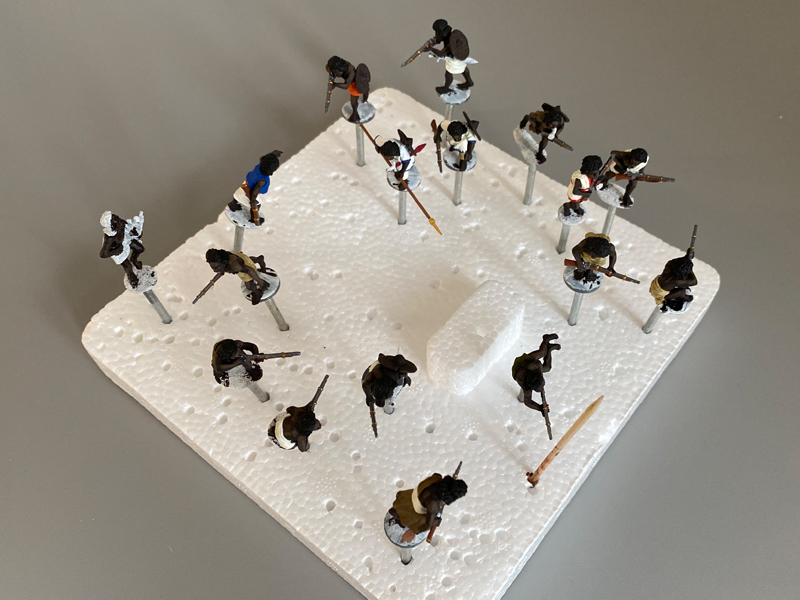
As I mentioned in my last post, the game markers are to indicate ‘pinned’ units and, specifically for the Beja, warriors who have ‘gone to ground’.

When I first saw Charles C Stadden’s plates of Royal Marine Light Infantry in the Sudan, I considered adding a red stripe to all the figure’s trousers. However, it was difficult to verify whether this was historically accurate in-theatre, so I abandoned the idea. My recent decision to add Lieutenant-Colonel Albert H Ozzard gave me the opportunity to add stripes to his trousers, so I am pleased about that. I’m also rather pleased with the way Ashburnham’s facial hair turned out.

Top-to bottom: Game markers for ‘pinned’ and ‘gone to ground’, which are intended to be positioned behind a unit’s leader figure; Charles C Stadden’s plates of Royal Marine Light Infantry showing the red stripe on their trousers; Huyshe, Ashburnham, and Ozzard.

30 June 2024

Three more leaders and some game markers

The Men Who Would be Kings ruleset requires that each unit has an identified leader. To this end I needed three more personalities to lead the Empire units.

Lieutenant-Colonel Alfred George Huyshe CB commands 1bn Princess Charlotte of Wales’s (Berkshire) Regiment, Colonel Sir Cromer Ashburnham KCB commands 3bn King’s Royal Rifle Corps, and Lieutenant-Colonel Albert Henry Ozzard commands the Royal Marine Light Infantry contingent in HMS Tyne.

The main additions are lanyards for the drawn pistols and characteristic moustache and sideburns for Ashburnham.

My Hadendowa are lead at rub level, with these leadership characteristics also applied to each band. Each band has an individual leader figure, so that an individual band can become leaderless.

Once I have completed the three British leaders all my units will have an individual leader figure. This makes leaderless units easy to mark. I am making some ‘pinned’ and ‘gone to ground’ markers; the former will be a shield on a small scenic base, with a tuft added for the latter.

Lieutenant-Colonel Albert Henry Ozzard, Colonel Sir Cromer Ashburnham KCB, Lieutenant-Colonel Alfred George Huyshe CB, and the first of the game markers.

19 August 2022

Royal Navy contingent

I’ve finished my Royal Navy contingent for my Suakin campaign … well, until I start work on the armed train.

Left-to-right: HMS Hecla’s company of Blue Jackets, commanded by Captain Arthur Wilson; RMLI company from HMS Tyne, Gatling gun battery, and company of Blue Jackets. Rear: Private Thomas Edwards (1 Black Watch) with a pair of ammunition mules. Front: Rear Admiral Sir William Hewett VC KCB and staff. Wilson and Edwards would be awarded VCs for their actions at second El Teb and Tamai respectively.

06 March 2022

Progress while an east wind blows

I’ve been hunkered down with my RMLI and Naval Brigade, finally finishing them.

Meanwhile a hoard of Hadendowa and another British infantry company are ready for painting, and I am beginning to think about modelling the Jack Tars hauling the Gatling gun limber, and a screw gun carried by mules or camels.

Top to bottom: The Naval Brigade contingent from HMS Hecla join their chief, Captain Arthur Wilson; the RMLI company from HMS Tyne; Rear Admiral Sir William Hewett VC KCB; war correspondents and great friends Melton Prior and Bennet Burleigh.

24 January 2022

RMLI and Naval Brigade contingents ready for varnishing

This year I have surprised myself with my rate of progress; uncharacteristically, and against a busy month work-wise, two Empire units are ready for varnishing.

These will almost complete the Royal Navy’s contribution to the field force, two Naval Brigade contingents (one each from HMS Carysfort and HMS Hecla) and a RMLI company (from HMS Tyne). At some point I will add the Gatling gun limber and the Blue Jackets hauling it; the limber is assembled, but still lacks wheels.

RMLI company and Naval Brigade landing party ready for varnishing.

06 January 2022

On the painting desk

Here’s a quick update of work in progress, as the heliograph section and Bennet Burleigh are ready for base detailing, the RMLI company are ready for shading and highlighting, while the next Naval Brigade contingent begins to come to life.

Three stages of progress: Bennet Burleigh and the Heliograph section, the RMLI company, and the next Naval Brigade contingent.

26 December 2021

Season’s greetings from the Royal Marine Light Infantry

Firstly, season’s greetings, wherever you are and whatever you are doing … reading this perhaps. Secondly, I wish you all a healthy, safe, and prosperous new year in the face of the continuing challenges of the pandemic.

I’ve had a bit of time to progress my RMLI company, and they are beginning to look the part, with mainly retouching to do now, before shading and highlighting. I’m rather homing to have these done before the second anniversary of my first post.

The RMLI company to be deployed by HMS Tyne, when they’re ship-shape.

06 August 2021

On the painting desk

I had a bit of time to do some painting, but didn’t feel like doing the final detailing the Naval Brigade figures require.

I had a another two bands of Hadendowa warriors assembled and/or prepared for painting, so I set about the blocking in. I now have more figures ready for detailing than I have ever had … at any time … ever.

Top, left to right: two Hadendowa,  spear and sword armed bands, one camel-mounted band, command group, and one rifle armed band.

Bottom: The first Naval Brigade company is ready for detailing, while the RMLI company is barely started. All figures are Perry Miniatures.

25 December 2020

Having a merry little white Christmas

Season’s greetings, and here we are, or rather here I am, almost a year since I published my first blog post, almost three years since I ordered Go Strong into the Desert – where the gestation for this project began, and a year since I received my first order of figures from Perry Miniatures. Over 2,000 page views and three, yes three, followers.

Progress hasn’t been as rapid as I should have liked – even the lockdowns were filled with a major professional project, which is ongoing, and will continue to demand much of my time. Overall then, I am not too unhappy with my progress … I now have a clear idea of the structure of the project in terms of the overall scope, unit composition, army composition, modelling projects, and so on.

On the subject of unit composition, I have revisited this and decided to increase the RMLI and infantry companies to 24 figures, two half companies of 12. This was prompted while looking at the composition of the infantry unit in melee, which had been bothering me for a while. I concluded that the addition of some kneeling and reloading figures would give it more of the character of the eye witness sketches (usually worked up by the artists at The Illustrated London News or The Graphic). Rather than substitute figures I decided to add some, increasing the unit size.

I am now thinking along the following lines:
– Naval Brigade companies 20 figures
– Infantry and RMLI companies 24 figures
– Cavalry troops 6 figures, squadrons 12 figures

This allows for a standard size infantry unit of 24 (a company) for Black Powder and a regular infantry unit of 12 (a half company) for The Men Who Would Be Kings. Cavalry troops are a bit small for The Men Who Would Be Kings, but I think I can live with this, since I would rather not have expensive cavalry figures left over (given that there are three in Perry Miniatures’ codes). Much of this is about the look of the unit on the table … too few figures at 28mm just looks wrong. For the same reason I am making batteries units of two models.

Accordingly I purchased some extra figures; two sprues of plastic Afghanistan/Sudan infantry; six kneeling/receiving infantry; six firing/reloading infantry. I also bought some additional Beja riflemen and crouching spearmen.

White-out … undercoated buildings, tents for the British field hospital, and small barricades including one of sand bags … plenty of sand in the Sudan.

Undercoated RMLI (top) Naval Brigade (middle), Beja camel band, and Melton Prior, with Burnaby just out of shot … reloading, probably. (Did you see what I did there?)


Not much progress with these … I am replacing the flag bearer with a metal rifleman, since I want these fellows to be stealthy.

08 August 2020

New recruits and some preparation

I don’t find hot weather conducive to painting, but I do need to get a bit of a shift on as I have decided I would like to have enough figures finished for a game over Christmas.

I had a toner cartridge delivered recently, which yielded a couple of large-ish pieces of polystyrene. I had a bit of time today so put one of these these to good use, and prepared and primed the second RMLI half company.

A couple of days ago I received the replacements for the poorly cast Naval Brigade figures. The new recruits are lovely and crisp – just as they should be. Great service from Perry Miniatures.

The second RMLI half-company.


Crisp new recruits for the Naval Brigade.

12 July 2020

First RMLI half-company

I am lucky to be generally busy just now, which tends to leave little time for my hobby, and my Sudan project has languised for too long without tangible progress in the form of finished units.

In order to keep up the psychological momentum I have decided to try and establish a rolling process of figures in preparation and figures being painted, with modelling and conversion projects alongside.

At the moment I have limited space for figures on my painting block of polystyrene, so have decided to progress my British forces in half-companies of ten figures.

I decided on an alternative sergeant, moving his arm forward slightly to make the pose more compatible with the ‘fire at will’ stance of this unit. The work on reducing the thickness of the bayonet was worthwhile.

The first half company of Royal Marine Light Infantry begin to shape up.

07 July 2020

First of the RMLI

I have parked the Naval Brigade detachment for the moment and started work on a company of Royal Marine Light Infantry.

The first task was to add a bayonet to the Sergeant I’ve selected, so that he is armed in the same way as his comrades.

A bayonet with some guts behind it.

08 March 2020

Infantry units: to mix or not to mix

I have been thinking about the mix of figures for my RMLI and infantry companies, in particular the level of uniformity in the poses.

I have figures firing and loading from Perry Miniatures infantry firing line (SB9) and standing volley firing (SB10), and infantry in melee (SB12), so, Blu Tack at the ready once again, I thought to experiment with mixing the figures to see which I preferred the appearance of.

One of my objectives is to achieve some of the characteristics of the eye witness drawings published in The Illustrated London News, many of which are reproduced in Mike Snook’s excellent Go Strong into the Desert (highly recommended if you are interested in this era).

I also have an eye on future purchases, and the poses I am considering, particularly for Highland (Black Watch) and Mounted Infantry (KRRC) units, the former charging and the latter skirmishing. I am considering a box of plastic infantry to represent a company of the Royal West Kents, my late father’s regiment.

My preference is for a more standardised approach, for these two units, at any rate.

RMLI company with a mixture of volley firing, reloading, and melée poses.
Infantry company with a mixture of volley firing, reloading, and melée poses.
RMLI company with volley firing and reloading poses.
Infantry company with melée poses.