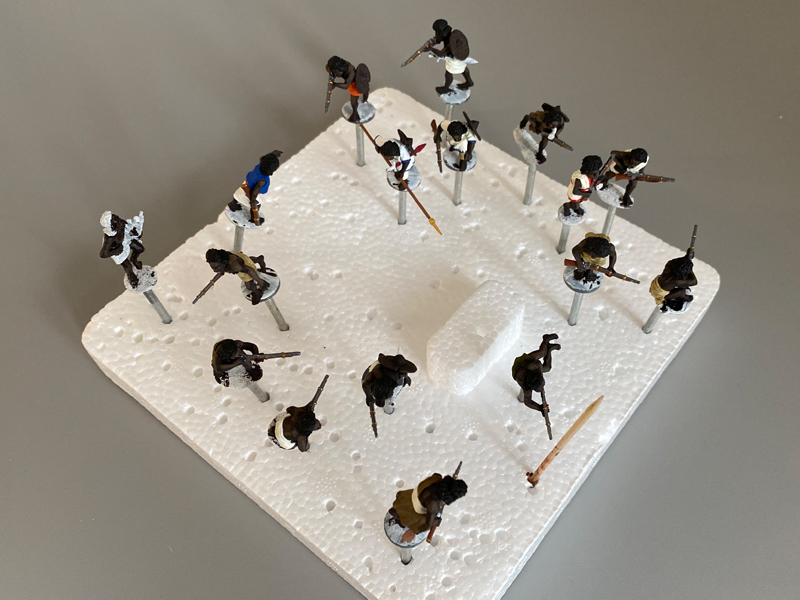
I’ve finished a small set of 16 game markers, which I hope will be enough, and the three leader figures are ready for varnishing.
As I mentioned in my last post, the game markers are to indicate ‘pinned’ units and, specifically for the Beja, warriors who have ‘gone to ground’.
When I first saw Charles C Stadden’s plates of Royal Marine Light Infantry in the Sudan, I considered adding a red stripe to all the figure’s trousers. However, it was difficult to verify whether this was historically accurate in-theatre, so I abandoned the idea. My recent decision to add Lieutenant-Colonel Albert H Ozzard gave me the opportunity to add stripes to his trousers, so I am pleased about that. I’m also rather pleased with the way Ashburnham’s facial hair turned out.
Showing posts with label TMWWBK. Show all posts
08 July 2024
30 June 2024
Three more leaders and some game markers
The Men Who Would be Kings ruleset requires that each unit has an identified leader. To this end I needed three more personalities to lead the Empire units.
Lieutenant-Colonel Alfred George Huyshe CB commands 1bn Princess Charlotte of Wales’s (Berkshire) Regiment, Colonel Sir Cromer Ashburnham KCB commands 3bn King’s Royal Rifle Corps, and Lieutenant-Colonel Albert Henry Ozzard commands the Royal Marine Light Infantry contingent in HMS Tyne.
The main additions are lanyards for the drawn pistols and characteristic moustache and sideburns for Ashburnham.
My Hadendowa are lead at rub level, with these leadership characteristics also applied to each band. Each band has an individual leader figure, so that an individual band can become leaderless.
Once I have completed the three British leaders all my units will have an individual leader figure. This makes leaderless units easy to mark. I am making some ‘pinned’ and ‘gone to ground’ markers; the former will be a shield on a small scenic base, with a tuft added for the latter.
|
| Lieutenant-Colonel Albert Henry Ozzard, Colonel Sir Cromer Ashburnham KCB, Lieutenant-Colonel Alfred George Huyshe CB, and the first of the game markers. |
25 December 2020
Having a merry little white Christmas
Season’s greetings, and here we are, or rather here I am, almost a year since I published my first blog post, almost three years since I ordered Go Strong into the Desert – where the gestation for this project began, and a year since I received my first order of figures from Perry Miniatures. Over 2,000 page views and three, yes three, followers.
Progress hasn’t been as rapid as I should have liked – even the lockdowns were filled with a major professional project, which is ongoing, and will continue to demand much of my time. Overall then, I am not too unhappy with my progress … I now have a clear idea of the structure of the project in terms of the overall scope, unit composition, army composition, modelling projects, and so on.
On the subject of unit composition, I have revisited this and decided to increase the RMLI and infantry companies to 24 figures, two half companies of 12. This was prompted while looking at the composition of the infantry unit in melee, which had been bothering me for a while. I concluded that the addition of some kneeling and reloading figures would give it more of the character of the eye witness sketches (usually worked up by the artists at The Illustrated London News or The Graphic). Rather than substitute figures I decided to add some, increasing the unit size.
I am now thinking along the following lines:
– Naval Brigade companies 20 figures
– Infantry and RMLI companies 24 figures
– Cavalry troops 6 figures, squadrons 12 figures
This allows for a standard size infantry unit of 24 (a company) for Black Powder and a regular infantry unit of 12 (a half company) for The Men Who Would Be Kings. Cavalry troops are a bit small for The Men Who Would Be Kings, but I think I can live with this, since I would rather not have expensive cavalry figures left over (given that there are three in Perry Miniatures’ codes). Much of this is about the look of the unit on the table … too few figures at 28mm just looks wrong. For the same reason I am making batteries units of two models.
Accordingly I purchased some extra figures; two sprues of plastic Afghanistan/Sudan infantry; six kneeling/receiving infantry; six firing/reloading infantry. I also bought some additional Beja riflemen and crouching spearmen.
![]() |
| White-out … undercoated buildings, tents for the British field hospital, and small barricades including one of sand bags … plenty of sand in the Sudan. |
24 February 2020
Infantry unit sizes and basing
I have been thinking about the sizes of my units from a number of perspectives: the number of figures specified by the rules I am considering (The Men Who Would Be Kings and Black Powder); the number of figures and different poses in each of Perry Miniatures’ packs; appearance – which will look right on the table; and cost.
With Blu Tack at the ready, and working with the figures I have so far, I considered: six other ranks plus two command figures, twelve other ranks plus two command figures, and eighteen other ranks plus two command figures. The six plus two option was for Naval Brigade detachments, since historically these units were usually small; but this just looked a bit mean when the figures were placed together on bases.
For now I have settled on twelve plus two for Naval Brigade detachments (I have enough figures for two of these), and eighteen plus two for other infantry companies (although I could see these going to twent-two plus two command figures).
I also need a couple of sergeants with fixed bayonets, so I will order an infantry command pack too. All this means that there will be a few spare figures, but I am certain these will find their way into other units or vignettes.
These combinations look right to me, should work with both sets of rules, and give a good visual distinction between the strengths of units from the different services.
I am likely to base four figures on a 60mm x 60mm base. This will give a slightly open looking deployment, which is informed by a post of Mike Snook’s on the (sadly, now defunct) Victorian Wars forum:
I have allowed a hypothetical one yard per two-rank file in calculating frontages, which is obviously an extra foot over the 24 inches of the ‘infantry drill’. There’s [sic] really two reasons for that. First this isn’t the drill square at Horse Guards, (where nobody fires volleys); rather it’s an undulating piece of rock-strewn desert. People give themselves that little bit more room to prevent the constant jostling effect that would otherwise arise from being dead shoulder to shoulder. Secondly, in order to fire, the book states that the rear rank men in the file come up on the left side of the front rank men. I have estimated the effect of these two things as being an extra foot per file. To be clear: two soldiers to each three feet of frontage where a company has turned towards the enemy and intends to fire a volley.
![]() |
| Naval Brigade, wearing sennet hats: six ratings plus two command figures. |
![]() |
| Naval Brigade, wearing caps: twelve ratings plus two command figures.
|
![]() |
| The fellow on the left will be armed with a Martini-Henry rifle, which needs a sling and a cutlass bayonet. |
05 January 2020
First recruits and sundries
This post marks the beginning of a project I have been thinking about for over 18 months. At the outset I read Mike Snook’s excellent Go Strong into the Desert, which led me to seriously consider the early years of the Mahdist uprising for my miniature adventure.
I like the idea of improvised armoured trains, paddle steamer gunboats, and marauding slavers, while the romance of the Nile and the desert are major draws.
Just before Christmas I received my first deliveries from a handful of manufacturers and suppliers.
I needed some additions to my scenic palette to allow modelling of mimosa for landscaping and, importantly, zarebas. Accordingly I bought some rubberised horse hair. I also bought brown short and long tufts, and tall shrubbery in yellow/green and natural hues.
I am considering The Men Who Would Bed Kings for rules, and gave the organisation of my forces some thought, but failed to form any firm conclusions about composition for the British. So I decided to order miniatures for Naval Brigade, Royal Marine Light Infantry, and King’s Royal Rifle Corps units, with some medics and war correspondents for vignettes; I settled on early war Beja (the Fuzzy Wuzzys of Kipling’s poem), and ordered two boxes of plastic figures, metal rifle armed, and camel mounted warriors, all from Perry Miniatures.
I also bought the Blood on the Nile Black Powder supplement, principally for the Fred Burnaby miniature, but it turns out to be an excellent source of inspirational photographs.
I bought Union Flags and White Ensigns from Flags of War. I will need to buy some flags for the Beja too … The Virtual Armchair General’s extensive range looks suitable.
![]() |
| My first Perry Miniatures order: metal Naval Brigade, RMLI, King’s Royal Rifle Corps, and Beja … |
![]() |
| … more Beja, and a handful of tents … |
![]() |
| … and Blood on the Nile for the Fred Burnaby figure, (the volume is full of great photos). |
![]() |
| Union Flags and White Ensigns will stake out the territory the plucky Brits are hanging on to! |
![]() |
| I needed some additions to my stash of scenics, and rubberised horse hair for mimosa thorn bush. |
Subscribe to:
Posts (Atom)